
What Happened: Major GLPI Release
On October 1, 2025, the GLPI project announced the general availability of GLPI 11, a major release succeeding GLPI 10 launched in April 2022. The three-year development cycle delivered substantial functionality improvements addressing IT service management requirements across diverse organizational contexts.
GLPI, maintained by French company Teclib and released under open-source licensing, serves thousands of IT departments globally managing assets, service requests, incidents, and compliance workflows. The 11.0 release represents a watershed moment for the platform, bundling previously separate plugins into core functionality and introducing entirely new automation and security capabilities.
Release Scope and Development Timeline
Following typical open-source practices, GLPI released release candidates in summer 2025 to solicit community feedback and bug reports. The final stable version arrived on schedule, incorporating community contributions and security hardening. This measured approach ensures production stability for organizations running GLPI in mission-critical environments.
Teclib continues offering both free open-source deployments and commercial GLPI Network subscriptions providing support, premium plugins, and managed cloud hosting. The release maintains backward compatibility with previous GLPI versions, permitting organizations to upgrade existing installations without wholesale replacement.
Technical Analysis: Feature Architecture and Capabilities
Native Custom Assets and CMDB Flexibility
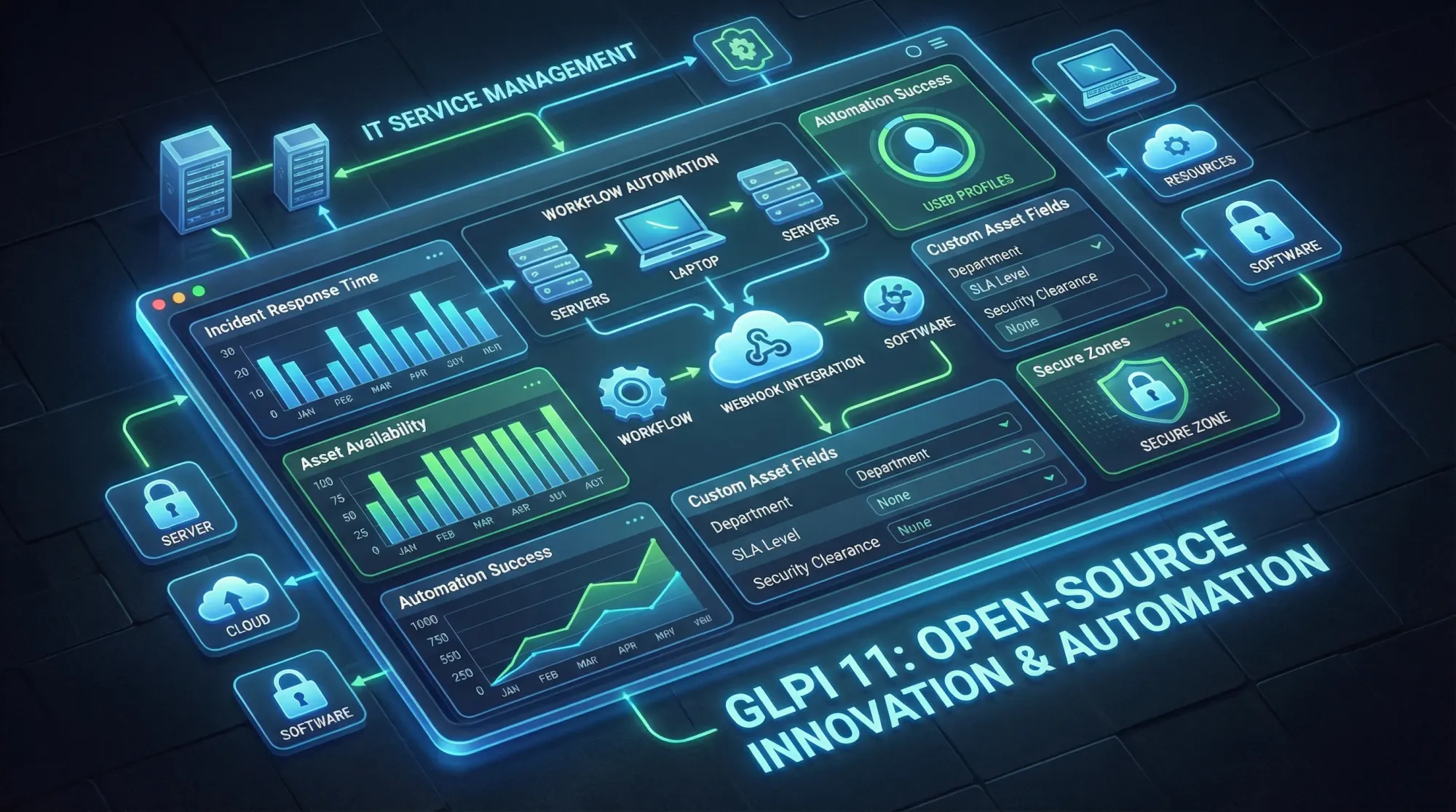
The most significant architectural change consolidates the Generic Objects and Fields plugins into GLPI core. Organizations can now create unlimited custom asset types directly within GLPI, enabling management of diverse asset categories beyond traditional IT inventory.
For example, organizations can establish custom asset types for servers, virtual machines, network infrastructure, software licenses, mobile devices, or non-IT assets like vehicles and facilities. Each custom asset type supports tailored fields, behavioral capacities, and access permissions independently configured per asset category.
The CMDB capabilities now support multi-group asset assignment, enabling organizations to model complex ownership structures and functional relationships. Assets can inherit permissions based on group membership, facilitating fine-grained access control for large enterprises managing geographically distributed infrastructure.
Webhook Integration and Event-Driven Automation
Webhooks enable GLPI to trigger HTTP requests to external systems upon detecting specified events. When tickets reach particular statuses, assets change states, or specific conditions occur, GLPI automatically notifies external systems—ITSM platforms, communication tools, project management systems, or custom integrations—without manual intervention.
Security-conscious webhook design includes multiple authentication mechanisms: SHA256-signed secret keys, challenge-response validation, OAuth token-based authentication, and configurable request expiration windows. Organizations can implement enterprise-grade security practices for webhook communications.
Advanced filtering enables selective event notification, preventing unnecessary webhook triggers and reducing external system load. Conditional logic determines which events warrant external notification, supporting sophisticated automation workflows.
Form Builder and User Interaction
The new form designer provides drag-and-drop functionality, visual form preview during construction, and conditional field visibility based on user responses. Organizations can create custom forms for incident submission, change requests, access provisioning, equipment procurement, or any user-facing workflow requiring structured data collection.
Forms support multi-language translations, field-level validation, calculated fields, and conditional branching. The forms integrate seamlessly with GLPI's ticket system, automatically populating tickets with collected form data and routing them to appropriate service teams.
Multi-Factor Authentication and OAuth Authorization
GLPI 11 implements native TOTP-based two-factor authentication, securing user accounts through time-based one-time passwords compatible with standard authenticator applications. Organizations can mandate 2FA globally, per user, per group, or per role, providing flexible security policies accommodating different user populations.
An integrated OAuth authorization server transforms GLPI into an identity provider for external applications. Applications leverage GLPI accounts for authentication and authorization, centralizing identity management across the IT ecosystem. The OAuth implementation supports standard authorization flows suitable for web applications, API clients, and service-to-service integrations.
API Modernization and Developer Experience
The new REST API uses OpenAPI 3.0 specifications, providing standardized documentation and automatic code generation capabilities. Legacy API endpoints remain supported, ensuring backward compatibility while developers migrate to modern interfaces.
OAuth-secured API access provides granular permission control per API client, enabling organizations to restrict specific applications to necessary resources (inventory access, ticket management, reporting) without granting universal system access.
Impact: Why This Matters to IT Organizations
Consolidation of Plugin-Dependent Workflows
Organizations previously managing GLPI through multiple plugins—Generic Objects, Fields, Form Creator—can now consolidate these dependencies into core functionality. This reduces deployment complexity, update management overhead, and version compatibility tracking.
Smaller organizations and resource-constrained IT departments benefit substantially from simplified deployments requiring fewer third-party component installations and maintenance.
Automation Expansion Beyond GLPI Boundaries
Webhooks enable integration patterns previously requiring custom development or expensive middleware. Service desk teams can trigger automated notifications, logging, archival, or downstream system updates directly from GLPI events.
MSPs and organizations with multi-system toolchains gain capabilities to coordinate workflows across platforms, reducing manual coordination and enabling genuine end-to-end process automation.
Enhanced Security Posture
Native multi-factor authentication protects accounts from credential compromise. OAuth-based API access eliminates requirements for creating administrative accounts with excessive permissions for integrations.
Security audit logging captures comprehensive event history, supporting compliance frameworks requiring detailed audit trails of administrative access and configuration changes.
Competitive Positioning Against Commercial Platforms
GLPI 11 delivers capabilities historically associated with expensive commercial ITSM platforms while remaining free and open-source. Organizations evaluating commercial platforms should revisit GLPI given the substantial capability improvements in version 11.
Expert View: Strategic Platform Evolution
GLPI's evolution reflects maturation of the open-source ITSM landscape. Previous versions occupied a niche as capable but functionally constrained alternatives to Jira Service Management, ServiceNow, or BMC Remedy. GLPI 11 narrows this gap substantially, delivering enterprise-grade features—custom asset modeling, event-driven automation, identity federation—without commercial licensing costs.
The plugin consolidation strategy indicates Teclib's commitment to sustainable development. Rather than accumulating ad-hoc plugins, the team systematically evaluates popular plugins and integrates them into core, ensuring ongoing maintenance and compatibility.
However, GLPI's strength remains vulnerability. The open-source community continues smaller than ServiceNow or Jira, limiting available third-party expertise and commercial support options. Organizations considering GLPI should budget accordingly for community-supported implementations or Teclib's commercial support offerings.
What to Do Next: Evaluation and Migration Planning
For Current GLPI Deployments
Existing GLPI 10 installations should schedule testing of GLPI 11 in non-production environments. The upgrade path is straightforward but warrants validation of custom plugins, customizations, and integrations against the new version.
Organizations relying on Generic Objects or Fields plugins should plan migration to native custom assets, leveraging the consolidated core functionality and eliminating plugin maintenance overhead.
For Organizations Evaluating ITSM Platforms
GLPI 11 merits serious consideration in procurement evaluations competing with commercial platforms. Total cost of ownership calculations should account for licensing savings and include GLPI Network support costs (optional) versus mandatory commercial platform support and licensing.
Pilot deployments in specific departments provide risk-controlled evaluation opportunities without enterprise-wide commitment.
For MSPs and Managed Service Providers
GLPI 11's webhook capabilities and OAuth identity federation enable sophisticated multi-customer service delivery models. MSPs should explore automation opportunities leveraging webhooks to coordinate ticketing, billing systems, and communications platforms.
The custom assets capability enables vertical-specific ITSM deployments—telecommunications infrastructure management, data center asset tracking, industrial equipment management—expanding addressable markets.
Conclusion
GLPI 11 represents a significant milestone for open-source ITSM platforms, delivering enterprise-grade capabilities previously requiring custom development or commercial platform investments. Custom asset types, webhook automation, integrated form builder, and native two-factor authentication position GLPI competitively against commercial alternatives for organizations prioritizing cost control and open-source commitment.
The platform's continued development under Teclib's stewardship ensures ongoing evolution addressing emerging IT operations requirements. Organizations should evaluate GLPI 11 for ITSM initiatives, particularly those seeking to control licensing costs without sacrificing functionality.
Related reading: GLPI installation and configuration guides, comparing open-source vs. commercial ITSM platforms, and webhook automation best practices.
Sources
-
GLPI Project Official – GLPI 11 Release Announcement – https://www.glpi-project.org/en/glpi-11-is-out/
-
GLPI Help Center Documentation – Webhook Configuration and Security – https://help.glpi-project.org/documentation/modules/configuration/webhook
-
OMNICOM Digital – Discover the New GLPI 11 Features and Enhancements – https://www.omnicom.digital/en/2025/11/17/discover-the-new-glpi-11/
-
LIOP Blog – GLPI 11: Central News for IT Asset and Service Management – https://blog.liop.com/de/glpi-11