

Introduction
Telex is WordPress’s latest experiment in AI-driven web development. Introduced in late 2025 as a “vibe coding” project, it allows users to describe what they want on their website in plain English. From that description, Telex automatically generates a fully functional Gutenberg block that includes front-end code, configuration, and styling.
What began as a demonstration quickly evolved into a real-world tool. Within months, developers and designers started deploying Telex-generated blocks on production sites, confirming that the concept works beyond the lab.
How Telex Works
Telex is built on a simple idea: describe a feature and get a plugin. A user can type something like “a calculator that lets users estimate shipping costs” or “a carousel of partner logos with hover animations.” Telex processes the prompt using a code-generation AI model trained on Gutenberg architecture and delivers a downloadable ZIP file ready to install as a WordPress plugin.
Each generated block integrates directly with the WordPress editor and can be styled using the standard block interface. No coding or manual file editing is needed, only a natural language workflow that reduces development time from hours to minutes.
Real Use Cases
At WordPress’s annual State of the Word event in December 2025, Telex was shown running live on production sites. Community contributors demonstrated blocks created entirely from prompts, including pricing calculators, store-hour banners, partner sliders, and custom post grids.
One example featured a dynamic grid that automatically adjusted card heights to maintain perfect visual alignment across varying content lengths. Another showcased a contact information block that combined live store hours, a phone link, and a Google Maps embed, all generated in less than two minutes.
Who It Is For
Telex targets a broad audience including small business owners who need custom functionality but cannot afford a developer, agencies that want to prototype features faster, and developers who want to use AI to scaffold boilerplate code before refining it manually.
For designers, Telex acts as a creative partner that turns rough ideas into usable components instantly, freeing teams to focus on layout, branding, and user experience. For developers, it accelerates production cycles and standardizes structure across multiple projects.
Benefits and Limitations
Telex dramatically speeds up the process of creating WordPress blocks and bridges the gap between concept and execution. Its AI handles the repetitive aspects of code scaffolding while users retain full control over design and customization.
However, it remains an experimental technology. Generated code should always be reviewed for best practices, security, and accessibility. Some blocks may require manual adjustments to ensure compatibility with complex themes or existing plugins. As with all AI tools, quality improves with detailed prompts and iterative testing.
The Future of Vibe Coding
Telex embodies a growing shift in software development toward what Matt Mullenweg calls vibe coding, building software by describing intent rather than writing syntax. This paradigm could change how people interact with WordPress entirely, turning the CMS into a semi-autonomous creative partner.
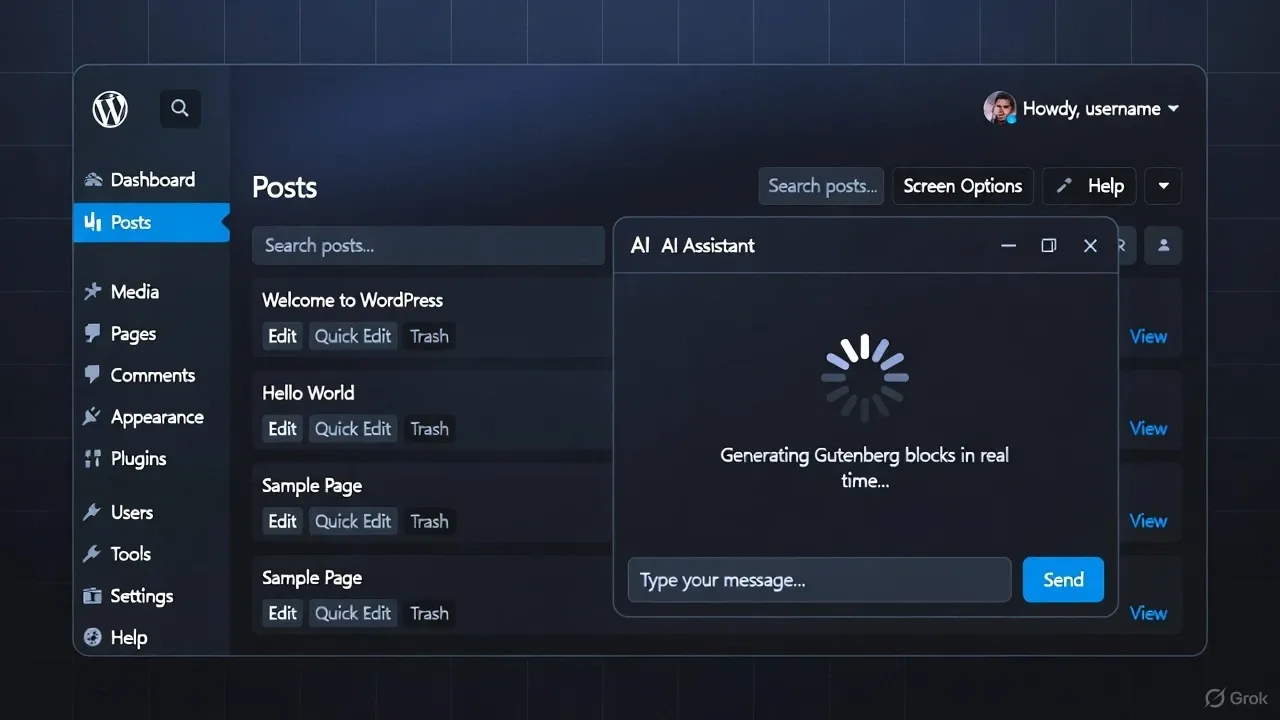
The long-term vision is for Telex to evolve into an AI assistant natively integrated into WordPress, enabling real-time code generation and live preview directly inside the editor. If successful, it could redefine plugin creation and make WordPress development accessible to millions of non-technical creators.
Conclusion
Telex demonstrates how far WordPress has come in merging AI with web creation. It simplifies development, accelerates prototyping, and lowers the barrier for anyone who wants to build something unique. Though still experimental, Telex’s early success shows that natural-language coding is no longer theoretical, it is already shaping real websites.
For agencies, developers, and small businesses, Telex represents the next leap in productivity: an AI that turns ideas into code with precision and context.
Sources
TechCrunch – WordPress’s Vibe-Coding Experiment Telex Has Already Been Put to Real-World Use
WordPress Blog – Telex Turns Everyone Into a WordPress Block Developer
TechCrunch – WordPress Shows Off Telex, Its Experimental AI Development Tool
Implicator.ai – WordPress Telex Aims at Vibe Coding with a Blocks-Only AI That Ships ZIPs